
Small RNA Sequencing
Small RNA Sequencing and miRNA Sequencing at Nucleome Informatics
Welcome to Nucleome Informatics, your leading partner in Small RNA Sequencing and miRNA Sequencing services. With over 10 years of extensive experience in this field, we offer cutting-edge technologies, a proven track record, and a diverse clientele that encompasses academic researchers, pharmaceutical companies, and biotechnology firms. Whether you’re exploring microRNA (miRNA) expression profiles, small RNA regulation, or biomarker discovery, our expertise will unlock the potential of your research.Sample Requirement
Our Small RNA Sequencing and miRNA Sequencing services accommodate various sample types, including total RNA
and enriched small RNA samples. The following are the sample requirements for successful sequencing:
- Sample Quantity: A minimum of 500 ng of total RNA is required for Small RNA Sequencing
and miRNA Sequencing library preparation.
- Sample Purity: RNA samples must have an RNA Integrity Number (RIN) of 7 or higher to
ensure minimal degradation and contamination.
- Sample Concentration: RNA samples should have a concentration of at least 25 ng/μl.
Sequencing Details
For Small RNA Sequencing and miRNA Sequencing, we utilize state-of-the-art next-generation sequencing platforms, providing the following read lengths and number of reads per sample:- Read Length: Our standard sequencing offers read lengths of up to 150 base pairs (bp), enabling precise identification of small RNA species and detailed profiling of miRNA expression (SE50bp).
- Number of Reads per Sample: We ensure deep coverage of your small RNA samples with a minimum of 10 million reads per sample or more. This high read depth enhances the sensitivity and accuracy of miRNA expression analysis.
Workflow
1. RNA Isolation and Quality Control
- Optional RNA isolation service is available to ensure high-quality RNA extraction.
- Rigorous quality control measures are employed to assess the integrity and purity of the RNA samples.
2. Small RNA Library Preparation
- Specialized library preparation methods for constructing small RNA-seq libraries, including miRNAs and other small non-coding RNAs.
- Adapter ligation, reverse transcription, and size selection steps to capture a comprehensive range of small RNA species.
3. Library Quality Check
- Stringent quality checks to evaluate library size distribution, concentration, and adapter ligation efficiency.
4. Sequencing
- High-throughput sequencing on state-of-the-art platforms to ensure deep coverage and accurate profiling of small RNAs.
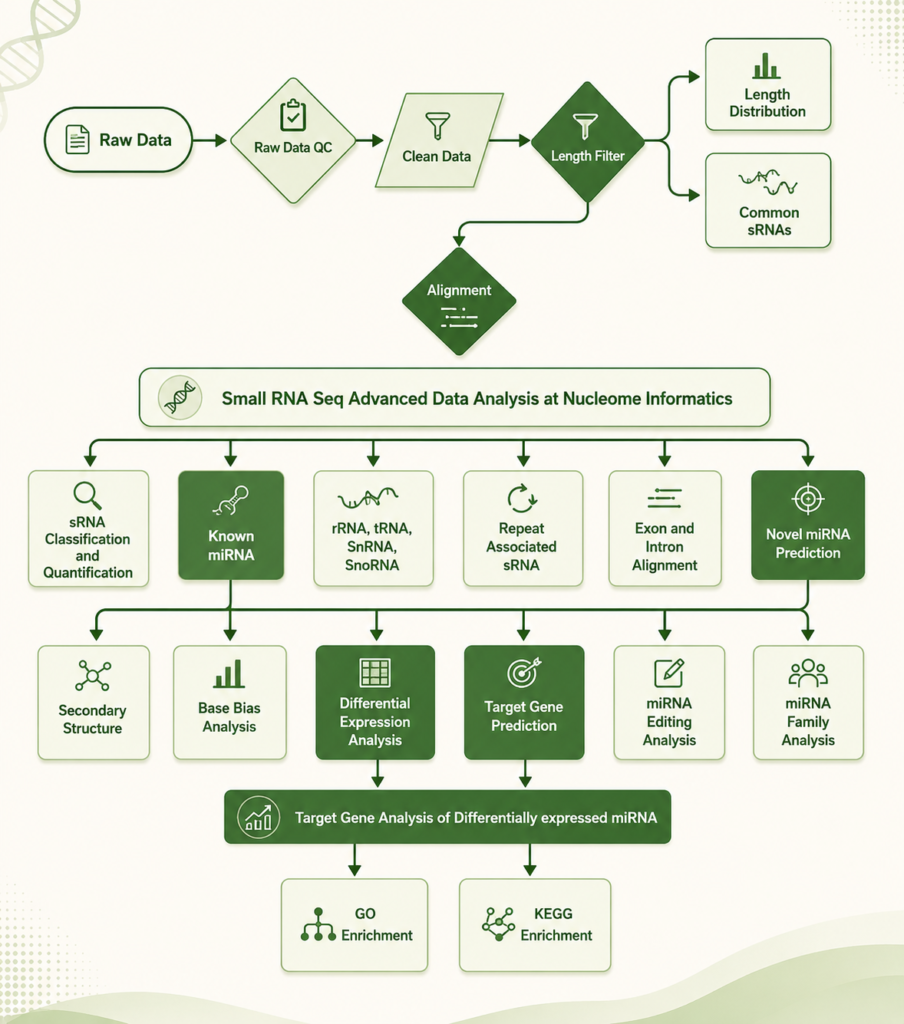
5. Data Analysis
- Alignment to small RNA reference databases for miRNA identification and quantification.
- Differential Expression Analysis to uncover significant changes in miRNA expression between experimental conditions or sample groups.
- Pathway analysis to gain functional insights into miRNA-target interactions.
- Customized bioinformatics analysis based on specific research objectives.
Applications in Plant, Animal, Human, and Disease Research
Plant Research
Small RNA Sequencing and miRNA Sequencing are widely used in plant research to study gene regulation, stress responses, and the role of miRNAs in developmental processes.Animal Research
In animal research, these sequencing techniques are applied to investigate miRNA-mediated gene expression control, neurodevelopment, and disease mechanisms.Human Research
Small RNA Sequencing and miRNA Sequencing play a crucial role in human research, aiding in the discovery of disease biomarkers, studying miRNA involvement in cancer, and understanding miRNA-based therapeutics.Disease Research
Our services are instrumental in disease research to identify disease-specific miRNA signatures, unravel disease mechanisms, and discover potential therapeutic targets. Discover the hidden potential of small RNA molecules with our Small RNA Sequencing and miRNA Sequencing services. Partner with Nucleome Informatics to propel your research to new heights.Contact us today to discuss your project requirements and benefit from our expertise in Small RNA Sequencing and miRNA Sequencing.