
Single Cell RNA Sequencing
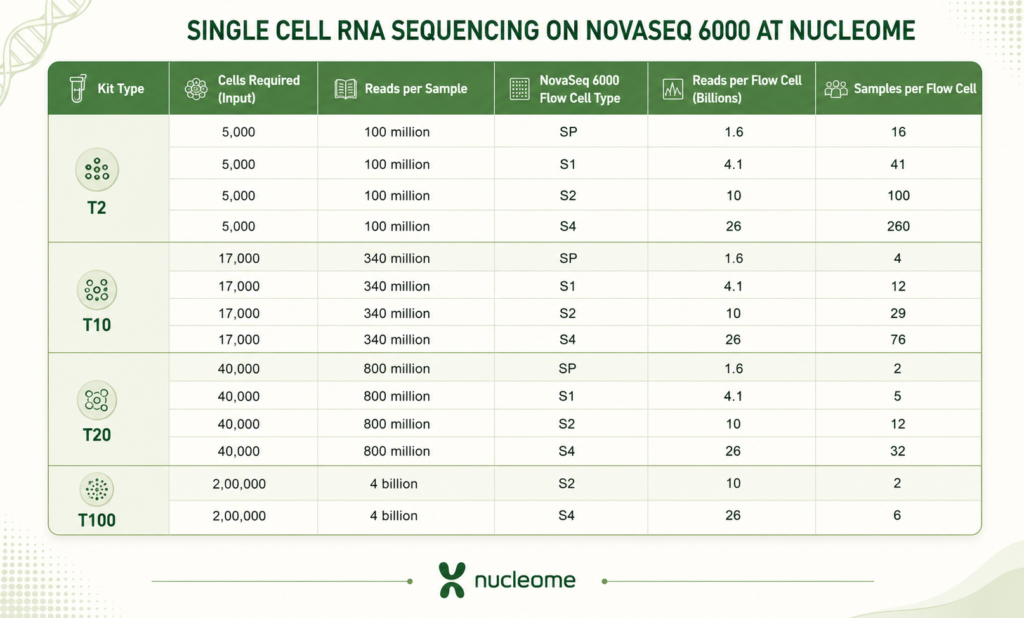
Sample Requirements
Input sample should be a single-cell suspension with a viable cell count depending on the kit size selected:- T2 kit: Requires approximately 5,000 input cells to recover 2,000 high-quality single cells.
- T10 kit: Requires ~17,000 input cells to recover 10,000 single cells.
- T20 kit: Requires ~40,000 input cells for 20,000 single cells.
- T100 kit: Requires ~200,000 input cells for up to 100,000 single cells.
Innovative Single-Cell RNA Workflow
The Illumina Single Cell 3 RNA Prep kit eliminates the need for complex microfluidic instruments by introducing a vortex-based PIPseq (Particle-Templated Instant Partitioning) chemistry. This novel approach captures individual cells into emulsified partitions containing barcoded oligonucleotides on hydrogel beads. Messenger RNA (mRNA) from each cell is then isolated, barcoded, and reverse transcribed to generate unique cDNA libraries for downstream Illumina sequencing. The workflow is streamlined into seven simple steps:- Cell suspension preparation
- Cell capture with PIPseq chemistry
- Lysis and mRNA capture
- cDNA synthesis
- Library preparation
- Sequencing on NovaSeq 6000
- Data analysis using Illumina DRAGEN Single Cell Pipeline and Partek Flow
Sequencing and Data Analysis
Using NovaSeq 6000, Nucleome delivers unmatched sequencing depth and data quality.- Each NovaSeq SP to S4 flow cell supports billions of reads, enabling dense sampling of up to 100,000 single cells per run.
- Output per flow cell can reach 26 billion reads, ensuring comprehensive transcript coverage across diverse cell populations.
- Sequencing depth is generally targeted at 20,000 reads per captured cell for optimal transcriptome coverage.
- Typical output per sample depends on kit size and desired cell number. Please see the table.
- Post-sequencing analysis includes cell clustering, transcript quantification, and differential gene expression profiling.
- Generation of ready-to-use feature-barcode matrices and publication-quality data visualizations.
Highlights of the Technology
- Detects high numbers of transcripts per cell, capturing delicate or rare cell types.
- Processes from hundreds to hundreds of thousands of cells, offering scalability suited to tissue-level and cell atlas projects.
- Compatible with methanol-fixed samples, enabling flexible experiment design across time points or remote collection sites.
- High sensitivity and low background noise reduce sequencing artifacts and maximize biological signal clarity.
- Highest throughput single-cell sequencing in India on NovaSeq 6000.
- End-to-end workflow from cell capture to publication-ready analysis.
- Expert bioinformatics interpretation for differential expression, clustering, and pathway enrichment.
- Flexible project design for both small-scale and population-level studies.
- Kits available for throughput ranging from 2,000 (T2) to 100,000 (T100) cells per sample.
Applications
With Illumina’s robust chemistry and Nucleome’s analytical expertise, this platform is ideal for:- Cancer Research Identifying tumor cell heterogeneity and immune escape mechanisms.
- Immunology Mapping immune cell differentiation and pathway activation.
- Neuroscience Profiling complex brain tissues and discovering novel neuronal subtypes.
- Developmental Biology Charting dynamic transcriptional programs during embryogenesis.
- Multiomics Integration Incorporating transcriptomics with proteomics or epigenomics from the same sample.